Tetra Tech, Inc. (NASDAQ: TTEK)
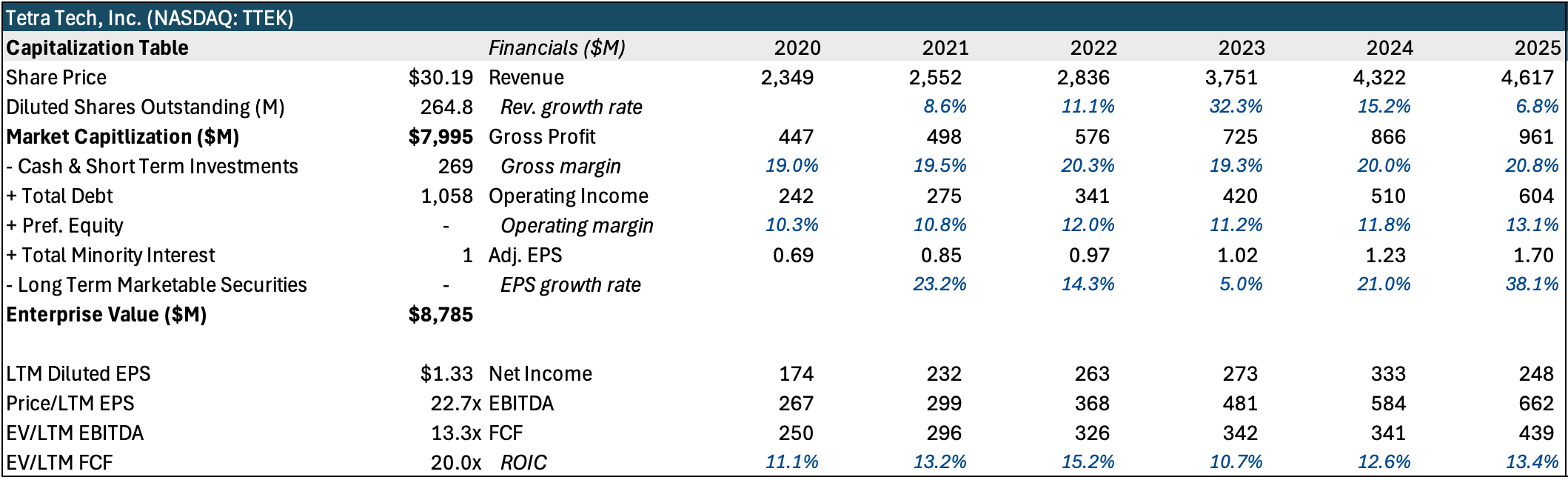
$8.7B Enterprise Value | $7.9B Market Cap | $30.19 Share Price (04/10/2026)
TTEK, headquartered in Pasadena, California, is a leading provider of high-end consulting and engineering services in water, environment, and sustainable infrastructure. Engineering News-Record has ranked Tetra Tech #1 in Water Treatment and Desalination since 2014.
Investment Summary
We recommend a long position in Tetra Tech, Inc. at $30.19 per share with a weighted 5-year price target of $85.11, representing a total return of 181.9% (23.0% IRR). The stock trades at 14.1x EBITDA versus a 19.4x five-year average, a de-rating driven by misplaced fears around AI disruption of the consulting sector and the USAID contract cancellations. We believe the market prices TTEK as a cyclical government contractor when it is, in fact, a mission-critical advisory platform with durable competitive advantages and structural margin expansion ahead.
Durable competitive moat in water and environmental engineering. TTEK is the federal government’s institutional knowledge base: its EPA models, datasets, and workflows are structurally embedded across all 10 EPA regions. The company has served the EPA since its founding in 1970 and owns 50 years of proprietary contaminant data on the Great Lakes. When five-year RFPs are issued, there is no credible alternative bidder. State and local water spending and emerging contaminants represent a decade-long structural demand runway the market has not yet priced.
Core compounder with high-ROIC capital allocation. FY2025 ROIC of 13.4% against a cost of capital consistently below 10%. Over the past decade, ROIC has ranged from 11.4% to 16.1%, consistently exceeding WACC. Incremental margins across FY2021 to FY2025 ranged from 11.4% to 29.6%, reflecting the operating leverage embedded in the business as digital tools scale and the revenue mix shifts toward higher-value work.
26 consecutive years of free cash flow generation. Total levered FCF from 2000 through 2025 was $3,882M. FCF grew at a 12.2% 10-year CAGR, driven by rising operating cash flow, a reduction in days sales outstanding from 70 to 57, and lower capex following TTEK’s exit from its construction business. FY2025 FCF was $439M.
13 consecutive years of dividend growth. Quarterly cash dividends have grown at a 12% compound rate. Current dividend yield is 0.86% ($0.26 per share annually). With a payout ratio of only 26% and minimal capex requirements, the dividend has substantial room to continue growing.
Structural secular tailwinds in global water and environmental services. The global water and wastewater treatment market is valued at $348B (2024) and projected to reach $652B by 2034 at a 6.5% CAGR. PFAS regulatory mandates are bipartisan and court validated. International frameworks in the UK and EU mirror the US regulatory trajectory with a 3-to-5-year lag, creating a second wave of demand.
AI is a margin tailwind, not a displacement risk. TTEK trades at a blanket sector discount applied to all consulting firms. Unlike peers, TTEK sits at the far end of the data-defensibility spectrum. Clients fund its R&D while TTEK retains the IP. Proprietary tools like Volans have reduced work that previously required ten engineers over six months to one engineer over three months. The margin benefit accrues to TTEK.
Variant View: What the Market Is Missing
Company Overview
Tetra Tech operates through two primary divisions: the Government Services Group (GSG), serving US federal, state, and local government clients (52% of FY2025 revenue), and the Commercial and International Group (CIG), serving US commercial clients and international government and commercial clients (48% of FY2025 revenue). By end-market, approximately 85% of revenue is derived from water-related services, 10% from high-performance buildings, and 5% from environmental and renewables work.
Revenue mix has shifted meaningfully over the past decade. US Federal declined from 30% (FY2016) to 32% (FY2025), while International grew from 28% to 37%. US State and Local has remained steady at 15%, and US Commercial has declined from 30% to 17% as the company has pursued higher-margin international opportunities. The Remediation and Construction Management segment was wound down beginning in FY2015 and represented less than 1% of revenue by FY2017.
Water Business (~85% of Revenue)
The water business spans three sub-segments: Watersheds (~47% of water revenue) delivers environmental services across rivers, lakes, and estuaries with core capabilities in contaminated sediments, water quality, bacteria control, and invasive species. Coastal Protection (~24%) focuses on sea level rise adaptation and catastrophic event response. Advanced Water Treatment (~24%) addresses emerging contaminants and complex water quality challenges, including PFAS remediation.
Key regulatory drivers include the US Clean Water Act, the UK’s AMP8 investment cycle, and Australia’s biodiversity performance standards. Representative contract awards include the US EPA Great Lakes Cleanup Services ($450M), United Utilities river health improvement ($125M), and Australia Defense coastal infrastructure planning (A$88M).
Environmental, Renewables & High-Performance Buildings (~15% of Revenue)
The renewable energy practice (~5% of group revenue) is focused on planning, permitting, engineering, and environmental assessment across offshore and onshore wind (~38% of renewable revenues), hydropower (~40%), and solar (~20%). TTEK estimates a combined North American addressable market of $11B per year and a UK/Europe/APAC market of $17B per year. The RPS acquisition established its presence in UK/EU offshore wind.
High-Performance Buildings (~10% of group revenue) targets an $18B annual addressable market. TTEK has completed over 200M sq ft of building decarbonization plans and has over 100 net zero buildings under design or completed. The segment is driven by AI-related data center demand, resilience requirements, and decarbonization mandates.
Competitive Moat Assessment
Tetra Tech Delta Platform (Strong). Proprietary SaaS and AI stack embedded in recurring utility workflows with high switching costs once integrated. WaterNet has been adopted by 75% of UK water utilities. Subscription software carries approximately 40% operating margins.
ENR #1 Water Ranking for 10+ Consecutive Years (Strong). A reputation moat compounded annually. The #1 ranking drives sole-source and preferred-vendor IDIQ awards, creating a self-reinforcing cycle of contract wins and further capability building.
IDIQ Contract Vehicles (Strong). Pre-competed vehicles with USACE, EPA, and other federal agencies act as barriers to entry. Incumbents win task orders at approximately 80%+ renewal rates. TTEK has won the EPA START contract six consecutive times across all 10 EPA regions.
Full Water-Cycle Capability (Strong). TTEK is the only firm spanning planning through design through digital operations through compliance. Peers are point-solution competitors. This end-to-end capability makes TTEK the default choice for complex, multi-year programs.
Federal Contract Moat: IDIQ Analysis
We analyzed 858,080 federal contracts from 2022 onwards by pulling data across comparable NAICS codes. 96% of TTEK’s federal government revenue flows through IDIQ (Indefinite Delivery, Indefinite Quantity) contracts, which are rarely re-bid once awarded. These vehicles function as a de facto moat: once TTEK wins an IDIQ, it receives a steady stream of task orders for the contract’s duration. The FAA engineering services contract, for example, has had 37 sub-tasks awarded to TTEK since 2021, approximately 2 per quarter, with no competitive re-bid.
Selected long-term pipeline projects that continue to generate recurring work include the EPA START VI contract (sixth consecutive win), FAA Engineering services (active, deepening relationship), expanding PFAS demand beyond EPA into defense and civilian agencies, and DoE nuclear cleanup site work where TTEK has been embedded for years.
Growth: Revenue Trajectory and Backlog
Net revenue grew at a 10.4% CAGR from FY2015 to FY2025, reaching $4,617M. Growth was driven by a combination of strategic acquisitions (Coffey International in 2016, WYG in 2019, RPS in 2023, Hoare Lea in 2025) and organic growth, particularly with US state and local and international clients. We estimate a 5-year forward CAGR of approximately 10%, with net revenue reaching $7,318M by FY2030.
Remaining Performance Obligations (RUPO)
RUPO, TTEK’s contracted backlog, grew at an 11.6% CAGR from FY2019 to FY2024, providing evidence of genuine demand accumulation. In Q2 FY2025, RUPO fell $1.1B in a single quarter as USAID contract cancellations hit. This was a discrete event, not a trend. Despite the cancellation, net revenue grew 7% in FY2025 as TTEK executed on its core water, environmental, and infrastructure backlog.
RUPO currently sits at $3.9B, approximately 0.85x FY2026E revenue. We see RUPO crossing 1x as a catalyst event for the stock, as PFAS remediation and infrastructure spending accelerates.
Emerging Contaminants: A Structural Tailwind
PFAS (per- and polyfluoroalkyl substances) regulation represents the most significant secular demand driver for TTEK’s water business. The regulatory framework is now bipartisan, court-validated, and expanding internationally.
Regulatory Framework
US EPA MCL reaffirmed at 4 ppt + CERCLA hazardous substance designation. EPA’s April 2024 rule established maximum contaminant levels for six PFAS compounds and designated all six as hazardous substances under CERCLA, compelling mandatory testing across an estimated 7 to 10% of US drinking water utilities. The Trump administration chose to preserve the 4 ppt MCL on PFOS and PFOA intact. The limit driving approximately 90% of remediation and treatment work has now survived across administrations, creating a demand floor that is effectively bipartisan.
UK First National PFAS Plan (February 2026). Defra published the UK’s inaugural PFAS Plan: a three-pillar framework covering source understanding, pathway reduction, and exposure management. The plan commits to consulting on a statutory drinking water limit in 2026 and expanding contamination monitoring by 2028.
EU Drinking Water and Groundwater Directives across all 27 member states. The recast Drinking Water Directive became mandatory from January 2026, and the European Parliament adopted updated Water Framework, Groundwater, and Environmental Quality Standards Directives in March 2026. With 46% of EU surface waters and 24% of groundwater already failing existing quality standards, the remediation pipeline is substantial and multi-decade in duration.
Market Sizing
The global water and wastewater treatment market was valued at $348B in 2024 and is projected to reach $652B by 2034 at a 6.5% CAGR. The advanced treatment sub-segment, driven by emerging contaminant removal, is the fastest-growing technology category at 8.5% CAGR. TTEK’s emerging contaminants segment currently represents approximately 9% of revenue and is growing at double digits year-over-year.
TTEK holds a knowledge moat in this technically complex field. Little is understood about the full scope of PFAS contamination, and TTEK has been building characterization, fate-and-transport, and treatment capability for years. International frameworks create a second wave of growth with a 3 to 5 year lag behind the US regulatory trajectory.
AI Is a Margin Driver, Not a Displacement Risk
The consulting sector has de-rated broadly on fears that AI will commoditize knowledge work. We analyzed the 1-year stock performance of TTEK’s closest peers and found that companies with minimal federal exposure have fallen just as hard as those with significant government revenue. The market is repricing the entire sector on AI disruption fears, not on federal budget cuts.
TTEK is positioned at the opposite end of the AI value chain from the firms genuinely at risk. The firms vulnerable to AI disruption are aggregators of publicly available information where the underlying data is replicable. TTEK is the entity collecting the proprietary data. Clients fund its R&D while TTEK retains the intellectual property, accumulating decades of proprietary software and datasets that no competitor can replicate.
Tetra Tech Delta: The Digital Platform
Tetra Tech Delta is the company’s suite of externally deployed digital tools developed using client R&D funding, where TTEK retains the IP and deploys the same tools across its wider client base. Digital water revenue is expected to grow from $250M (FY2025) to $500M (FY2030) under our base case.
WaterNet: A data-driven platform for finding and addressing water infrastructure leakage. Adopted by 75% of UK water utilities as of 1Q26.
Enterprise Automation: Acquired in 2022, provides data analytics and cybersecurity services. Cybersecurity is increasingly critical given EPA mandates requiring utilities to implement cybersecurity controls.
Csoft: Now live in the US, Canada, and the UK.
Volans: TTEK’s proprietary tool for modelling noise and air pollution impact on flight paths. Work that previously required ten engineers over six months now takes one engineer three months.
Tetra Linx, the internal ERP platform, gives every employee real-time visibility into project status. AI chatbots reduce the need for additional labor by automating project updates and reporting. Together, the internal and external platforms drive margin expansion from both the cost and revenue sides.
Margin Expansion: Pathway to 190 bps Improvement
Adjusted EBITDA margins expanded 280 bps from FY2015 to FY2025, driven by operating leverage, a shift away from remediation and construction management, and increased adoption of digital tools. Adj. EBITDA grew at a 12.8% 10-year CAGR, reaching $662M in FY2025. We see a clear pathway to an additional 190 bps of operating margin improvement by FY2030, from 15.1% to 17.0%.
Margin Bridge
USAID revenue mix shift (+80 bps). USAID work is structurally lower-margin (~7.3%) cost-plus work. Permanent removal shifts TTEK’s contract mix away from cost-plus toward higher-margin fixed-price. Management confirmed 80 bps of structural uplift on margins.
RPS integration (+25 bps). RPS was acquired in 2023 at approximately 4% EBITDA margins. It exited FY2024 above 12% operating margin and is expected to glide toward mid-teens. We model 25 bps improvement within CIG for FY2026 and FY2027, impacting consolidated margins by approximately 15 bps annually.
Digital subscription scaling (+80 bps). Digital Water revenue is expected to grow from $250M (FY2025) to $500M (FY2030). We allocate 40% operating margin to the broader subscription business. As subscription revenue scales from approximately 5% of total revenue to 7 to 8%, it pulls the blended margin higher.
Across FY2021 to FY2025, TTEK has delivered incremental margins of 11.4% to 29.6%, reflecting the operating leverage inherent in the business as automation scales. We forecast incremental margins between 16.0% and 18.0% from 2026 through 2030.
Capital Allocation
TTEK has historically operated with leverage below 1x Net Debt/EBITDA, with occasional modest increases reflecting M&A. As of 1Q2026, net leverage stands at 0.9x with over $2B of debt capacity and swift post-RPS deleverage. Capital allocation priorities, in order, are:
M&A. Management has 20+ years of disciplined tuck-in M&A. Focus on asset-light, people-driven targets limits integration risk. Q4 commentary showed openness to larger deals. We expect M&A on the horizon for 2027.
Buybacks. As of Q1 2026, $548M in total authorized buybacks available with $50M expected. Given the share price, we believe this could be accelerated to repurchase 5% of shares outstanding.
Dividends. Low capex requirements and a low payout ratio of 26%. We would like to see the 12% YoY growth continue.
Organic reinvestment. Given consistently high ROIC (11.4% to 16.1%), organic reinvestment remains an attractive use of capital on a risk-adjusted basis.
M&A Track Record
TTEK has developed a repeatable M&A playbook: acquiring technically differentiated firms at attractive valuations and consistently expanding margins post-close. Each acquisition must expand TTEK either geographically or technically. TTEK targets companies it has previously worked with that lack the capabilities to scale independently, lowering integration risk.
RPS Group (2023, $784M, 9.2x post-synergy EV/EBITDA). 4% EBITDA margins at acquisition, now mid-teens. Unlocked UK/EU Water and offshore Wind.
WYG (2019, ~$55M, ~13x EBITDA). UK-listed consulting firm. TTEK expanded margins from low-single-digits to mid-single-digits post-acquisition.
Coffey International (2016, ~$77M, ~3-4x EBITDA). Australia-listed consulting firm. TTEK doubled margins from approximately 4% to 8% within two quarters of close.
Halvik (2026, 9.6x EBITDA). Provider of advanced data analytics, systems modernization, and cybersecurity services for US defense and civilian agencies.
Management
TTEK completed an orderly CEO succession in February 2026, separating the Chairman and CEO roles. Dan Batrack, who joined in 1980 and served as CEO since 2005, transitioned to Executive Chairman. Roger Argus, with 30+ years at TTEK, was named CEO. Argus previously directed TTEK’s M&A program, identifying and integrating strategic acquisitions. We are encouraged to have him leading the business.
The board was refreshed in December 2025, with Jeffrey Feeler and Susan Hardwick joining as independent directors, replacing Christie Obiaya and Kimberly Ritrievi. All independent directors are now up for annual re-election. Kirsten Volpi serves as Lead Independent Director.
Other key executives include Steven Burdick (EVP and CFO since 2011), Leslie Shoemaker (EVP, Chief Innovation and Sustainability Officer, focused on Tetra Tech Delta), and Jonathan Weiss (President of CIG since October 2025, driving global water and energy nexus initiatives).
Valuation
TTEK trades at 14.1x EBITDA versus a 19.4x five-year average, approximately 15% below its historical P/E average. We believe the company is trading at suppressed levels given the exposure to US Federal Government contracts and the current administration’s posture, as seen in the USAID contract cancellations, combined with a blanket AI discount applied to the entire consulting sector.
Return Profile
Risk/Reward Scenario Analysis
The probability-weighted target reflects a 60% weight on our bull case ($116.50), a 25% weight on the management base case ($46.94), and a 15% weight on the downside ($23.20). Even in the downside scenario, cumulative dividends of $1.84 provide partial capital return. The asymmetry of the risk/reward profile is favorable: the bull case IRR of 31.0% against a downside IRR of -5.1% produces a weighted expected return well in excess of market alternatives.
Quality Assessment
The rate of return is only half the picture. How long and how reliably that return compounds matters as much as the headline IRR. We evaluate every investment across five quality dimensions: durability of the return, reinvestment capacity, cash flow predictability, degree of influence over value realization, and downside protection. For TTEK, the quality profile is strong across all five.
Durability
TTEK’s competitive position is anchored in two reinforcing moat sources: intangible assets (40 years of proprietary EPA data, the ENR #1 ranking, and institutional relationships that function as de facto sole-source arrangements) and switching costs (IDIQ contract vehicles with 80%+ renewal rates, and the Tetra Tech Delta platform embedded in recurring utility workflows). These are not advantages that erode quickly. The EPA relationship dates to 1970. The IDIQ vehicles are pre-competed and rarely re-bid. WaterNet, once adopted by a water utility, becomes part of the operational infrastructure. The realistic erosion path is a sustained technology shift that resets the cost structure of environmental consulting, or a well-capitalized competitor willing to invest decades replicating TTEK’s proprietary dataset. Neither is probable over a five-year horizon.
Reinvestment
TTEK has a long runway to redeploy capital at attractive rates. ROIC has ranged from 11.4% to 16.1% over the past decade, consistently exceeding the cost of capital. The business is asset-light (capex intensity below 1%), meaning nearly all operating cash flow is available for reinvestment. The M&A playbook provides a proven channel for deploying capital into margin-accretive tuck-ins. The Tetra Tech Delta platform creates a second reinvestment channel: client-funded R&D produces proprietary IP that TTEK retains and re-licenses, generating incremental revenue at 40% operating margins with minimal additional capital. The combination of organic reinvestment at high ROIC and capital-light subscription scaling is rare among companies of this size.
Predictability
Cash flow visibility is high. Over 70% of revenue is non-discretionary, tied to regulatory mandates (Clean Water Act compliance, PFAS remediation, CERCLA obligations) rather than discretionary project spend. The IDIQ contract structure provides multi-year revenue visibility, and RUPO of $3.9B represents approximately 0.85x forward revenue. The revenue model is predominantly fee-for-service with an increasing subscription component, and the client base is diversified across federal, state and local, commercial, and international segments. TTEK has generated positive free cash flow for 26 consecutive years, including through the 2008 financial crisis and the COVID period. The emerging contaminants demand floor is court-validated, not policy-dependent.
Control and Influence
As a minority public equity position, direct influence over management decisions is limited. However, several factors partially offset this. Management incentives are aligned: insider ownership is meaningful, the capital allocation track record is disciplined, and the new CEO was promoted from within after directing the M&A program. The board was refreshed in December 2025 with two new independent directors, and the separation of Chairman and CEO roles is a positive governance development. The stock is liquid ($90M average daily volume), providing the ability to increase or reduce the position as the thesis evolves.
Downside Protection
The margin of safety is supported by several layers. At $30.19, the stock trades at 14.1x EBITDA versus a 19.4x five-year average, providing valuation cushion even without thesis realization. The balance sheet is conservatively leveraged at 0.9x Net Debt/EBITDA with over $2B of debt capacity. The business generates $439M in annual free cash flow, and the 26-year FCF track record provides confidence that cash generation persists through adverse environments. In our bear case ($23.20, 10.0x P/E on $2.14 EPS), permanent capital loss is limited to 23% before dividends, and the scenario requires both a sustained earnings decline and a multiple that remains compressed below the historical floor. The moat erosion scenario that would justify that outcome — a competitor replicating TTEK’s proprietary data and institutional relationships — is low-probability over the investment horizon.
Key Risks and Mitigants
Reputational risk / ability to secure new contracts
Tetra Tech EC allegedly falsified soil samples at Hunters Point Naval Shipyard. TTEK settled DOJ claims for $97M in FY25 with a further $18M reserved for ongoing civil litigation, with no admission of liability. Federal exposure is now being closed, misconduct was isolated to a single subsidiary, and TTEK remains the dominant provider of water and environmental consulting to the US government, leaving agencies with few credible alternatives at scale.
Value-destructive capital allocation / M&A overpayment
Management has 20+ years of disciplined tuck-in M&A; focus on asset-light, people-driven targets limits integration risk. ~1x net leverage provides balance sheet flexibility without undue risk.
USAID revenue does not return / further federal cuts
USAID exit is already a margin tailwind. Even with zero recovery, consensus projects 10-11% EPS growth in FY2026. Core water/environment business has replaced USAID volume with higher-margin US state/local and UK work.
Fixed-price contract cost overruns
TTEK’s scientific front-end work provides superior cost certainty vs. traditional EPC contractors. Fixed-price exposure is concentrated in high-confidence water design projects; track record of overruns is limited and management monitors closely.
Foreign exchange risk
FX risk applies to 37.4% of revenue (AUD, CAD, GBP, EUR). Primary mitigation is natural hedging by matching revenue and costs in the same currency; for large transactions, forward contracts are used (e.g., the GBP hedge on the 2023 RPS acquisition).
Important Disclosures
The author holds a position in TTEK as of the date of publication. That position may change at any time without notice.
All publications are provided for informational and educational purposes only and do not constitute financial, investment, or economic advice. Investing involves risk, including the possible loss of principal. The views expressed are solely those of the author and do not necessarily reflect those of any affiliated organizations.


